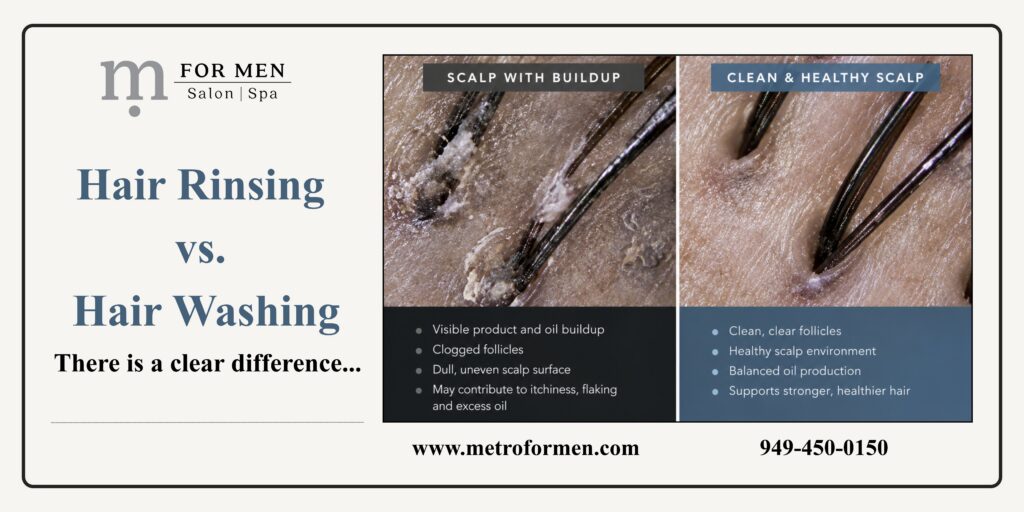
When you say you wash your hair, what does that actually mean? It is surprising how many men think getting their hair wet in the shower, rubbing their scalp with their fingers, and rinsing with water counts as washing hair. But rinsing your hair is different from actually cleansing it. Washing your hair involves more than water. It requires shampoo to help remove excess oil, sweat, dead skin cells, styling product residue, and environmental debris that accumulate on the scalp and hair. Understanding what shampoo does, why it matters, and how to use it properly is essential to maintaining a clean, balanced scalp and healthy-looking hair.
Here’s something men’s hairstylists and barbers hear all the time:
- “I wash my hair every day.”
- Then we ask, “What shampoo are you using?”
- The answer?
- “I don’t use shampoo. I just rinse it really well with my fingers.”
That’s not what washing hair actually means.
Rinsing the hair with water and rubbing the scalp with your fingers may remove some sweat, loose debris, and water-soluble residue. It does not effectively cleanse the scalp and hair of oil, sebum, styling products, sunscreen, pollution, and other buildup.
So what does shampoo actually do?
Shampoo is a cleanser. The scalp naturally produces sebum (oil). Add sweat, dead skin cells, styling products, environmental debris, and other substances; simply rinsing with water isn’t enough to remove everything. Shampoo contains cleansing ingredients called surfactants that help loosen oils, dirt, and product residue so they can be suspended in water and rinsed away.
Think of it this way:
💧 Water = rinsing
🧴 Shampoo + water = cleansing
Why Does Shampoo Matter?
Shampoo is one of the most important, yet frequently misunderstood, components of a proper hair-care routine. Many people see shampoo as a product that makes their hair smell clean, removes styling products, or creates a rich lather. In reality, shampoo serves a much more important purpose. It cleanses the scalp and hair by removing excess oil, sweat, dead skin cells, environmental debris, microorganisms, and accumulated hair-care products.
To understand why shampoo matters, it helps to understand what happens naturally on your scalp throughout the day.
The Scalp Naturally Produces Oil
Your scalp has thousands of sebaceous glands that produce an oily substance called sebum. Sebum travels along the hair follicle and coats the scalp and hair shaft. It helps lubricate the skin and hair, reduce moisture loss, and provide some protection. Sebum is not bad. In fact, it is a normal and necessary part of maintaining the skin’s protective barrier. The problem occurs when excess sebum combines with other substances and accumulates. A further problem occurs when excess sebum combines with other substances, accumulates, and clogs hair follicles.
Throughout the day, your scalp and hair are exposed to:
- Sebum: Natural oils produced by the sebaceous glands.
- Sweat: Perspiration that contributes moisture, salts, and other substances to the scalp.
- Dead skin cells: Your scalp continuously sheds old skin cells as part of its natural renewal process.
- Styling products: Hair creams, pomades, gels, clays, waxes, sprays, and other grooming products can leave residue.
- Environmental pollutants: Dust, airborne particles, smoke, and other environmental debris can settle on the hair and scalp.
- Microorganisms: The scalp naturally supports bacteria and fungi, including Malassezia yeast, which are part of its normal skin microbiome.
Water alone cannot effectively remove all of these substances, particularly oil-based materials and styling-product residue. This is where shampoo becomes important.
What is Shampoo’s Purpose?
Shampoo is specifically formulated to cleanse the scalp and hair. Its primary cleansing ingredients are called surfactants, also known as cleansing agents or detergents. Surfactants are particularly useful because they interact with both water and oil. One part of the surfactant molecule is attracted to water, while another part is attracted to oils and greasy substances. When you massage shampoo into your scalp, these cleansing agents help loosen and surround sebum, dirt, sweat, dead skin cells, and product residue. When you rinse, water carries these materials off the hair and scalp.
Think about washing your hands after handling something greasy. Running your hands under water may remove some loose debris, but it generally takes a cleansing product to remove the oil effectively. Your scalp works in much the same way.
Water rinses. Shampoo cleanses.
Shampoo also helps remove accumulated materials that may contribute to an uncomfortable scalp environment, including excess oil and product residue. Modern shampoos are formulated to do this while maintaining the hair’s manageability. Depending on the formulation, they may also contain conditioning ingredients, moisturizers, proteins, and other components intended to improve the feel and appearance of the hair. The goal isn’t to remove every trace of natural oil. It is to remove excess oil and accumulated debris without unnecessarily stripping the scalp and hair.
Why Is Shampoo Important Today?
Another question us men’s hairstylists and barbers get is, “People hundreds of years ago didn’t use shampoo; why do I need to use it today? This is an interesting question worth exploring. People have cleaned and cared for their hair for thousands of years. However, they didn’t always use what we recognize as modern shampoo. Historical hair-washing practices varied widely by geography, culture, available resources, and personal grooming habits.
Ancient civilizations used a variety of materials and techniques for washing hair, including:
- Plant extracts and botanical preparations.
- Soapberries and other naturally occurring cleansing plants.
- Herbal rinses and infused waters.
- Clay and other mineral-based cleansing materials.
- Oils and traditional grooming preparations.
- Soap made from combinations of fats, oils, and alkaline substances.
For example, traditional Indian hair-care practices used soapberries, herbs, and botanical preparations to cleanse and care for hair. In other cultures, people relied on water, oils, powders, and various traditional cleansing methods. The key point is that people cleaned their hair long before modern commercial shampoo existed. They simply used the cleansing resources available to them.
Modern shampoo developed through advances in chemistry and cosmetic formulation. These advances let manufacturers create products designed specifically for the scalp and hair, with different cleansing strengths and conditioning properties. Earlier cleansing methods were not necessarily equivalent to modern shampoo. Traditional soaps, for example, could be highly alkaline and potentially leave hair rough, dry, or difficult to manage. Modern shampoo formulations offer more control over how effectively they remove oil and residue while helping preserve hair manageability.
So why does this matter today? Because our grooming habits, lifestyles, and daily exposures have changed.
Modern Men’s Hair Care Has Changed
Consider how many men style their hair today. A typical grooming routine might include a pre-styling product, styling cream, pomade, clay, texture powder, finishing spray, or other products designed to create a particular hairstyle. These products serve a purpose, but they can also leave residue on the hair and scalp. Add daily perspiration, physical activity, exercise, environmental exposure, and naturally produced sebum, and you have several reasons why regular cleansing matters.
Some men shampoo their hair regularly. Others simply rinse their hair with water because they believe shampooing too frequently is unnecessary or harmful. A growing misconception is that avoiding shampoo altogether is healthier because it lets the scalp maintain its natural oils. While avoiding harsh or excessive cleansing can benefit certain hair and scalp types, eliminating shampoo entirely is not automatically a healthier choice. Your scalp still produces oil, sheds skin cells, and collects environmental debris whether or not you use styling products.
Water alone may remove some loose materials, but it is not as effective as shampoo at removing accumulated oils and oily residue.
For men who use styling products regularly, proper shampooing matters more because product residue can combine with natural scalp oils and other debris. The objective isn’t to shampoo as frequently as possible. It’s to shampoo appropriately for your individual scalp and hair needs.
What Happens When You Don’t Shampoo Often Enough
When shampooing consistently falls short of your scalp’s needs, sebum, dead skin cells, sweat, environmental debris, and hair-product residue can accumulate. This accumulation is commonly called scalp buildup.
Depending on the individual, scalp buildup may contribute to:
- An oily or greasy scalp.
- Hair that looks flat, heavy, or difficult to style.
- A coated or uncomfortable feeling on the scalp.
- Visible residue around the hair follicles.
- Increased flaking or scaling.
- An unpleasant odor associated with accumulated oil, sweat, and microorganisms.
- Scalp irritation or itching in some individuals.
Scalp buildup and a diagnosed scalp condition are not necessarily the same. For example, dandruff and seborrheic dermatitis involve more than simply having a dirty scalp. Malassezia yeast, sebum, individual skin susceptibility, and inflammatory responses can all play a role. Not shampooing adequately may contribute to oil and residue accumulation, but it does not mean that poor hygiene causes seborrheic dermatitis.
Likewise, an itchy scalp does not automatically mean you need to shampoo more frequently. Sometimes the problem is an unsuitable shampoo, excessive cleansing, contact irritation, or an underlying skin condition. That is why understanding your scalp matters as much as knowing which shampoo you use.
Does Everyone Need to Shampoo Every Day?
Absolutely not. No single shampooing schedule works for every man. The appropriate frequency of washing hair depends on several factors, including:
- How much natural oil your scalp produces.
- Your hair texture and density.
- Whether your hair is straight, wavy, curly, or tightly coiled.
- How frequently you exercise and perspire.
- Your occupation and environmental exposure.
- How much styling product you use.
- Whether you have a scalp condition that requires a particular cleansing routine.
For example, a man with fine, straight hair and an oily scalp may benefit from daily shampooing. Someone with coarse, curly, or very dry hair may need to shampoo considerably less frequently. Men who exercise daily or use substantial amounts of styling products may also need to cleanse more frequently than someone with a relatively inactive lifestyle and minimal product use.
The key is to recognize that shampooing isn’t inherently damaging when you use the right product and frequency. Overwashing with an overly harsh shampoo can remove too much of the scalp’s natural surface oil and leave the hair dry or rough. On the other hand, washing too infrequently can let excess oil and product residue build up.
Finding the right balance is what matters.
Shampoo Is Not Just About Clean Hair. It Is About Scalp Care.
One of the biggest misconceptions in men’s grooming is that hair care begins and ends with the haircut. A good haircut can improve your hair’s appearance, but it doesn’t address the condition of the skin underneath. Your scalp is living skin. It has sebaceous glands, hair follicles, a natural skin barrier, and a complex community of microorganisms. Like the skin on your face, it requires appropriate cleansing and care. Regular, appropriate shampooing is one of the simplest ways to help maintain a clean scalp environment.
However, shampoo is not a treatment for every scalp concern. It does not independently prevent genetic hair loss, reverse follicle miniaturization, or guarantee hair growth. If you experience persistent itching, inflammation, excessive flaking, sores, or changes in hair density, you may need a closer evaluation. Understanding what shampoo does—and using it correctly—is an important first step in better caring for your hair and scalp. Remember: Getting your hair wet is not the same as washing it. Proper hair washing means using an appropriate cleansing product to remove the oil, residue, and debris that water alone cannot effectively remove.
At m FOR MEN Salon | Spa, we believe that better hair care starts with understanding the scalp. Because caring for your hair means caring for the skin it grows from.
How Washing Hair is Properly Done
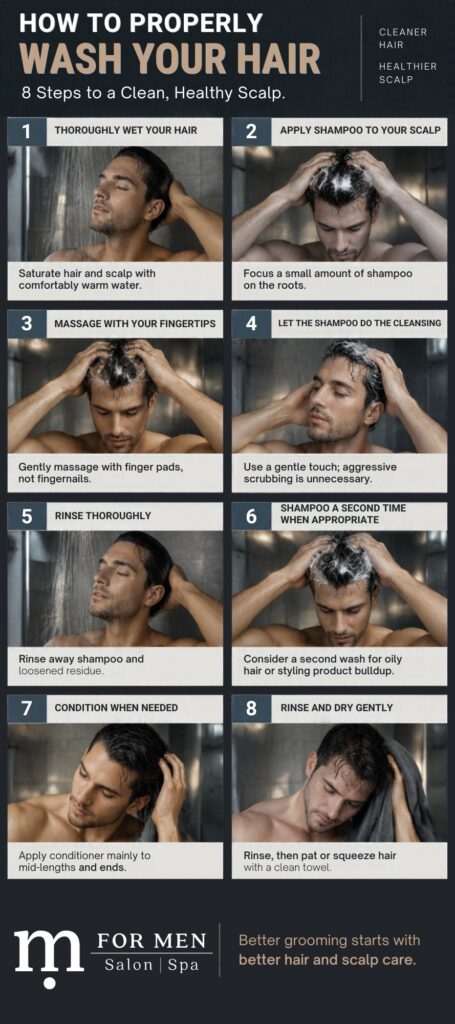
Knowing why shampoo matters is only half the equation. Knowing how to properly wash your hair matters just as much. Surprisingly, many men have never been taught the correct way to shampoo their hair and scalp. Washing your hair isn’t simply about applying shampoo, quickly rubbing your head, and rinsing it away. Proper cleansing involves using the right amount of shampoo, applying it where it is needed most, gently massaging the scalp, and thoroughly rinsing away loosened oil, debris, and product residue. The technique, products, and frequency all play a role in keeping your scalp clean and your hair healthy-looking. Let’s walk through the proper steps to make sure you’re washing your hair properly.
1️⃣ Thoroughly wet your hair.
Use comfortably warm water, and make sure your scalp and hair are fully saturated.
2️⃣ Apply shampoo to your scalp.
Focus the shampoo primarily on the scalp, rather than piling it onto the ends of your hair.
3️⃣ Massage with your fingertips.
Use the pads of your fingers—not your fingernails—to gently work the shampoo across the scalp. Pay attention to the hairline, crown, sides, and back of the head.
4️⃣ Let the shampoo do the cleansing.
You don’t need to aggressively scrub. Gentle, thorough cleansing is more important than force.
5️⃣ Rinse REALLY well.
Allow the water to carry the shampoo and loosened buildup away. Make sure you leave no cleanser behind.
6️⃣ Shampoo a second time when appropriate.
If your hair is particularly oily, dirty, or loaded with styling products, a second shampoo may be beneficial. The first wash helps break through buildup; the second can provide a more thorough cleanse.
7️⃣ Condition when needed.
Apply conditioner mainly to the mid-lengths and ends, depending on your hair type. Fine or short hair may require much less conditioner than longer or coarser hair.
8️⃣ Rinse and dry gently.
Don’t aggressively towel-rub your hair. Gently squeeze or pat out excess water, then style as usual.
An Important Point on Washing Hair
Clean hair doesn’t mean you need to scrub your scalp until it feels “squeaky clean.” Over-cleansing, harsh products, or aggressive scrubbing can irritate the scalp and may leave the hair feeling dry or rough. The right cleansing routine depends on your scalp, hair type, lifestyle, styling products, and how much oil and buildup you produce. If you’re experiencing persistent itching, flaking, excessive oiliness, scalp irritation, or changes in hair density, that’s more than a “dirty hair” problem. Your scalp may need a closer look.
Why Does My Scalp Itch Sometimes?
An itchy scalp is one of the most common complaints men experience. Yet it is also one of the most misunderstood aspects of scalp health. When your head starts itching, a man’s first thought might be dandruff or a dry scalp. But itching doesn’t always mean either. The scalp is living skin, with oil-producing glands, hair follicles, a protective skin barrier, and a naturally occurring community of microorganisms. Changes in oil production, accumulated product residue, inadequate cleansing, excessive cleansing, irritation, and certain skin conditions can all contribute to scalp discomfort. Understanding what causes a scalp to itch matters because treating the wrong problem with the wrong products can sometimes make it worse. Before reaching for an anti-dandruff shampoo or assuming your scalp simply needs more moisture, let’s take a closer look at what may actually be happening beneath your hair.
If you’ve ever caught yourself scratching your head and thought:
“Do I have dandruff?”
Not necessarily. An itchy scalp does NOT automatically mean you have dandruff or a dry scalp. Your scalp can itch for several reasons, including product irritation, excess oil and buildup, dry skin, dandruff, seborrheic dermatitis, psoriasis, allergic reactions, and other scalp conditions.
What Happens When the Scalp is NOT Properly Cleansed
Your scalp is skin. Just like the rest of your skin, it naturally produces sebum (oil) and sheds dead skin cells. Add sweat, styling products, environmental debris, and other residue; these materials can accumulate when the scalp isn’t properly cleansed. Regular shampooing with water helps remove oil, dead skin cells, and microorganisms that accumulate on the scalp. If buildup remains, your scalp may feel oily, coated, irritated, flaky, or itchy.
But here’s where things get interesting…
What is Malassezia?
Malassezia is a type of yeast that normally lives on human skin. Everyone has it. It isn’t inherently bad. However, in some people, the interaction between Malassezia, scalp oil, and the skin’s immune response can contribute to seborrheic dermatitis. Seborrheic dermatitis is a common inflammatory scalp condition that can cause itching, flaking, and greasy or scaly patches.
And that’s an important distinction:
Malassezia ≠ automatically dandruff.
Itchy scalp ≠ automatically Malassezia.
Flakes ≠ automatically dry scalp.
What is Dandruff?
Dandruff is commonly associated with seborrheic dermatitis and can cause itching and visible flakes. A dry scalp, however, is different. Dry skin happens when the skin loses too much moisture, while dandruff is more commonly linked to excess oil and the skin’s inflammatory response. The two can look and feel similar, so it’s easy to mix them up.
Thus is Why Proper Washing Hair Matters
Remember the earlier part of this post? RINSING IS NOT THE SAME AS WASHING HAIR. Running water over your head and rubbing your scalp may remove some surface debris. But shampoo is specifically designed to cleanse away oil, dead skin cells, product residue, and other buildup. Remember, the scalp doesn’t need aggressive scrubbing. It needs appropriate, consistent cleansing for YOUR scalp and hair type. And how often a person should shampoo isn’t the same for everyone. Someone with an oily scalp may need to shampoo much more frequently than someone with very dry, curly, or tightly coiled hair.
One Last Thing on Washing Hair…
If your scalp is persistently itchy, burning, inflamed, developing heavy scale, forming sores, or experiencing changes in hair density, don’t automatically assume you just need to “wash it more” or “use a dandruff shampoo.” An itchy scalp can have many causes, and persistent symptoms may need a dermatologist’s evaluation.
Your scalp is skin. And just like the skin on your face, it deserves more than a quick rinse under the shower.
What Does it Mean When Shampoo Doesn’t Lather?
Ever notice that your shampoo barely lathers the first time you wash your hair? There’s a reason for that! Your scalp naturally produces sebum (oil), and it can also accumulate sweat, dead skin cells, and styling product residue. These can interfere with lathering. When your hair and scalp have too much oil and product buildup, shampoo may not lather, which can be a telltale sign your scalp is compromised.
Here’s what you should know:
💧 The first wash: Shampoo may produce less foam as it works through oil and product buildup.
🫧 The second wash: If needed, a second shampoo may lather more easily because some of the buildup has already been removed.
⚠️ But remember: Less lather doesn’t automatically mean your scalp is dirty or your shampoo isn’t working. Water hardness, low-sudsing shampoo, and how much shampoo is being used can affect lather. So how can you tell whether it’s hard water, the amount of shampoo, or the formulation? Here are a couple of tips:
- Hard water: check with your water municipality if you are in an area known for hard water. There are also DIY testing hacks, and YouTube has some great videos on how to test your water.
- Amount of shampoo: Typically, men’s hairstylists and barbers recommend a dime-sized amount of shampoo. If you are using less than that, you may need more. However, if you do not wash your hair every day or at least every other day, a small amount of shampoo will not be enough. You may need more or a double shampoo.
- Shampoo formulation: Some manufacturers develop low-sudsing shampoos. Check the bottle label to see if your shampoo is one of those. For these shampoos, focus on how effectively they cleanse your scalp and hair, and not how they lather.
💈 The takeaway: Healthy hair starts with a healthy scalp!
Read on to learn what to do if your scalp has become overrun with sebum, hard water, and styling product build-up…
When the Scalp Needs Its Own Cleanser
A man’s scalp may need more than a regular shampoo when washing habits are inconsistent, cleansing is inadequate, or heavy styling products and excess oil accumulate over time. Skipping shampooing, relying mainly on water rinses, or using a shampoo that doesn’t fully remove accumulated sebum, dead skin cells, sweat, and product residue can contribute to buildup around the hair follicles. As this material accumulates on the scalp, it can coat or obstruct follicular openings, potentially contributing to irritation, itching, and an unhealthy scalp environment. A scalp cleanser provides a more targeted, deeper cleansing experience, helping loosen and remove stubborn buildup that routine shampooing may leave behind. Think of it this way: washing your hair keeps it clean, but properly cleansing your scalp helps maintain the environment where healthy hair grows.
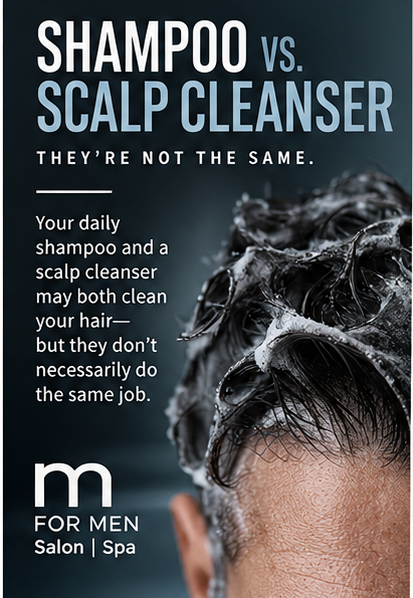
SHAMPOO ≠ SCALP CLEANSER
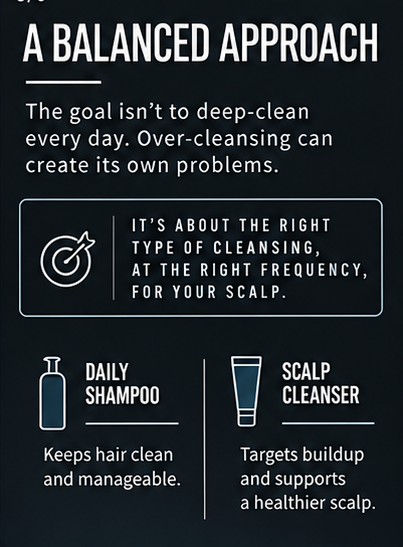
Your daily shampoo and a scalp cleanser may both clean your hair. But they don’t necessarily do the same job.
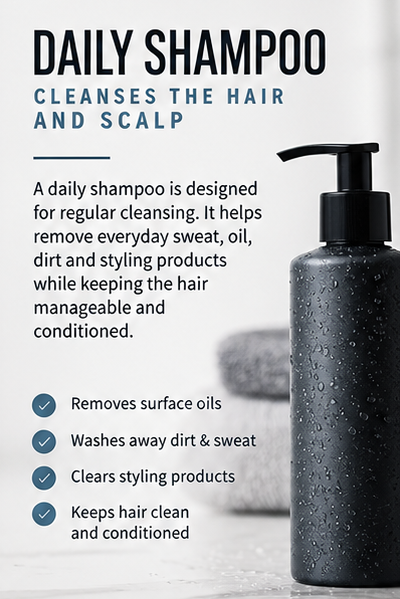
🧴 DAILY SHAMPOO
Designed for regular cleansing of the hair and scalp. It helps remove everyday sweat, oil, dirt, and styling products while keeping the hair manageable and conditioned.
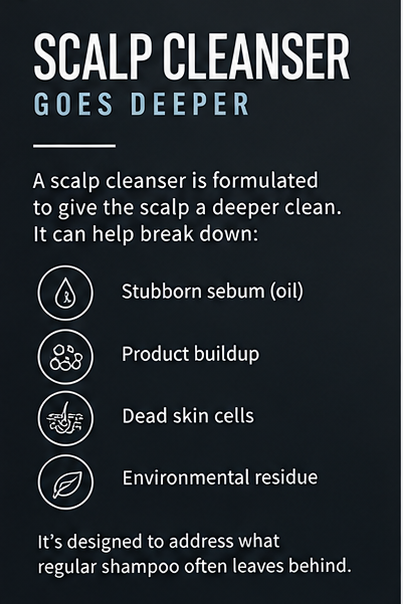
🧼 SCALP CLEANSER
Designed to give the scalp a deeper clean. It can help break down stubborn sebum, product buildup, dead skin cells, and environmental residue that may accumulate on the scalp over time.
Why does this matter when washing hair?
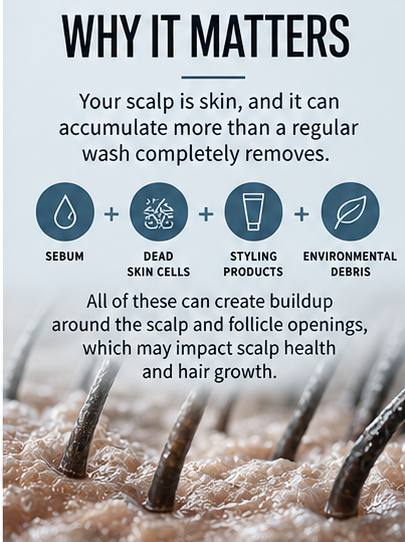
Your scalp is skin. And just like the skin on your face, it can accumulate more than a regular wash completely removes. Sebum + dead skin + styling products + environmental debris can create buildup around the scalp and follicle openings. That doesn’t mean you need to deep-clean your scalp every day. In fact, over-cleansing can create its own problems. The goal is the right type of cleansing, at the right frequency, for your scalp. Healthy hair starts with a healthy scalp.
Clean scalp. Healthy habits. Better hair care. — m FOR MEN Salon | Spa
Hair and Scalp Wellness Services
At m FOR MEN Salon | Spa, we believe healthy-looking hair starts with understanding the scalp. Not just the haircut or washing hair. Hair concerns don’t always begin with the hair itself. Changes in hair density, excessive shedding, breakage, oiliness, dryness, flaking, or an uncomfortable scalp can be signs that your hair and scalp need a closer look. At m FOR MEN Salon | Spa, we take a different approach. We look beyond the haircut to understand the condition of the hair and scalp so we can create a more informed path forward.
Our NEW Hair & Scalp Wellness Services are designed for men and focus on assessing, cleansing, balancing, and supporting scalp and hair health. Led by Krista Martin, master men’s hairstylist, associate trichologist, and men’s grooming expert, these services combine professional observation, specialized tools, and targeted treatments to help you better understand what is happening beneath the surface. Whether you’re experiencing changes in your hair or simply want to be more proactive about maintaining a healthy scalp, the first step is taking a closer look.
The hair and scalp wellness services at m FOR MEN Salon | Spa focus on every detail. Browse our list of services:
Hair and Scalp Wellness Consultation | $75
Not sure what your hair or scalp needs but know something feels off? This personalized consultation is the first step toward understanding what may be affecting your hair and scalp. We will discuss your concerns, hair-care routine, and goals, and assess your hair and scalp to determine which of our Hair & Scalp Wellness services may be right for you. You’ll leave with a clearer understanding of your hair and scalp and a personalized recommendation for your next step.
Digital Scalp Assessment | $125
See your scalp and hair in a way you simply can’t see in the mirror. Our Digital Scalp Scope uses magnification and high-resolution imaging to provide a close-up view of the scalp and hair follicles, helping reveal details that may otherwise go unnoticed. Such as excess oil and buildup, flaking, redness, irritation, or changes in the appearance of the scalp and hair. Seeing what’s actually happening beneath the surface gives us a clearer starting point for discussing your hair and scalp concerns and determining which professional treatments and home-care products may be appropriate for you. It’s a simple, visual first step toward understanding your scalp and making more informed decisions about your hair growth and scalp wellness. Regular scalp scoping can help document changes related to hair loss and a hair regrowth journey.
6-Package Series | $550
Hair Density Assessment | $85
Looking for a measurable answer to your hair thinning question? A professional hair density assessment using the HairCheck® tool can help. This scientific tool precisely and accurately measures hair loss, growth, and breakage in any area of the scalp. This non-invasive assessment, performed by a licensed cosmetologist and hair-loss specialist, can help identify and treat hair loss before it shows. It can also measure the effectiveness of hair growth products, quantify hair loss due to thinning, shedding, and breakage, and monitor measurable changes in hair density over time. When repeated under consistent conditions, these measurements can help document changes associated with hair loss and a hair regrowth journey.
Hair Density Progress Assessment | $65
Hair and Scalp pH Assessment | $65
Concerned about hair thinning, experiencing breakage, changes in hair texture? Are you having scalp discomfort and/or red, itchy bumps? Maybe you want to optimize hair growth or desire to maintain healthy hair and scalp. This service is for you. We know hair growth begins at the scalp, so it needs to be at its peak pH level. Understanding the hair and scalp environment can be an important part of a proactive hair and scalp care plan. This non-invasive assessment uses a pH checker pen and pH test strips to evaluate the approximate pH of the scalp and hair. We consider results alongside hair and scalp condition, product use, cleansing routine, and other observations to identify areas where a current hair-care routine may need adjusting to bring hair and scalp to their optimal pH for hair growth. The goal is to establish a professional baseline and provide personalized recommendations for cleansing, scalp care, conditioning, and product selection that support a healthy hair and scalp environment.
Hair and Scalp pH Follow-up | $45
Hair and Scalp Detox | $75
Does your scalp feel itchy, tight, or greasy even after washing your hair? Does your hair feel dull, dry, rough, and breaking? Your hair and scalp are begging for a full detox treatment. We start with a scalp detox to remove buildup of sebaceous oil, dead skin cells, and product residue that a regular shampoo cannot remove. Our scalp detox uses products containing activated Vitamin C, Zinc, Panthenol, and Biotin. This powerful mixture helps remove deposits and restore the scalp to its optimal pH level. We follow up with a hair detox treatment using chelating agents that bind to metal ions and mineral deposits like hard calcium, magnesium, and copper found in most tap water. These agents go beyond a clarifying shampoo that only removes oil and product buildup. Our hair detox restores hair to a healthy, shiny state and makes it responsive to hair growth serums. The goal of our hair and scalp detox treatment is to regulate sebum production, reduce inflammation, support healthy cellular turnover, and smooth the hair cuticle to reduce hair shedding and breakage, which are all critical for healthy hair growth.
Add Hair and Scalp Repair Treatment | $75
Dandruff/Dry Scalp Relief Treatment | $45
Flakes got you down? Our dandruff/dry scalp relief treatment uses zinc gluconate, panthenol, vitamin C, and biotin to restore balance to the scalp skin. Zinc promotes scalp health by reducing inflammation, regulating sebum production, and soothing the scalp. A balanced scalp can help alleviate dandruff and dry scalp. Dandruff and dry scalp flakes contribute to follicle-clogging buildup, and persistent itching can contribute to hair shedding and breakage. Proactively supporting a healthy scalp environment is key to healthy hair growth.
3-package series | $120
Add Hair and Scalp Repair Treatment | $75
Swimmers Hair Treatment | $45
A crystallized vitamin treatment that helps neutralize chlorine and remove copper and other pool elements. This treatment reduces dryness, tangles, discoloration, and “green” hair. This treatment aims to reveal softer, shinier, healthier-looking hair after being in chlorinated or saltwater pools.
3-package series | $120
Add Hair and Scalp Repair Treatment | $75
Hair and Scalp Repair Treatment | $75
Is your scalp itchy, tight, or have red bumps? Does your hair feel rough, dry, or breaking? Your hair and scalp need a repair treatment. We start with a hair and scalp detox to remove surface product and environmental buildup. Then we follow up with a moisturizing shampoo and apply a deep conditioning mask to the hair and scalp. The mask is left to penetrate deep into the hair, repairing the cuticle and the scalp skin to rehydrate the follicles. The goal of the hair and scalp repair treatment is to improve hair’s manageability, reduce dryness and roughness, and moisturize the follicles, creating a healthier environment for optimal hair growth.
Add Hair and Scalp Detox | $75
Scalp Microdermabrasion w/ Scope | $115
This scalp microdermabrasion goes beyond our scalp detox service and targets sebaceous oils and dead skin cells trapped in the hair follicles. These natural filaments block hair growth by choking off the blood supply and suffocating the hair strand, preventing it from forming. We start this treatment by using our digital scope to assess each hair follicle and determine the severity of the blockage. After understanding the blockage, we determine how many treatments are needed to clear and open the follicles, allowing for new hairs to form. Typically, three (3) once-a-week treatments are needed for full hair follicle clearance, but results may vary based on blockage severity.
3-Package Series | $315